
Saturday, December 02, 2006


 A young monk similar to one I chatted to today. He spending 2 years in a single monastary, getting up at 4 am to chant, then meditate, then free time, then more of the same in the evening. 'No freedom', he said, 'same every day.' When I asked him why he'd signed up for so long he said something about family expectations.
The oldest and most important wat in Luang Prabang pictured (more pics swiped from t'internet until I get around to posting my own) is rather splendid, and has several satellite buildings one of which is a kind of garage for the last king's hearse, which is itself also rather impressive. Overall the style is architecturally similar to the wats in Chiang Mai, but details such as the layered roofs and roof-corner ornamentation differ. Also, the sculpted depiction of the Buddha differs in some respects, and has an emphasis on the standing 'praying for rain' posture.
The Luang Prabang museum is housed in the old king's palace, which was built by the French. In it there are wonderfully airy chambers sparsely furnished with, among other things, very old lockers for leaf-paper inscriptions. Among the gifts on display the most incongruous is a model of the lunar module of Apollo 11 and a piece of moon rock (actually missing) which was sent with a personal message from Richard Nixon in the early 70s, stating that the Lao flag was on board when the module landed. I don't know if every world leader received such a gift, but I found out today that Laos is the most-bombed nation per capita in the history of warfare. Even more incongruous to find, then, that the country was neutral throughout the Vietnam war, and that the CIA illegally (against the Geneva convention) operated bombing raids from Laos using agents and pilots ostensibly positioned as aid and development workers. The bombs were dropped by American pilots returning from raids, in order to comply with orders to come back with bomb bays empty. Operations from Laos were carried out in secret, and unlike Nam, no media correspondents were allowed in the area. The American public never even knew. So much for democracy.
As for the Communist North Vietnamese, they also occupied parts of Laos illegally, stationing huge numbers of troops in the north east of the country.
The years after the end of American withdrawal and the fall of South Vietnam were turbulent for the Lao. The King and his family, imprisoned in a cave by the Communists who wrested long-term power after a series of coups and counter-coups in 1975, died of neglect, starvation and disease within a few years.
Now it seems the ruling Party, despite the presence of an old-guard educated in hard-line Vietnam, are gradually modernising and liberalising in the face of a sceptical peasant power-base who would rather get on with life in the manner that the Thais, their closest historical and cultural allies, have done all along.
Anyway, Laos today seems to be thriving. I had an excellent day pedalling between the wats, around the markets, and out to the local countryside, and watching the sun set over the might Mekong was really rather special. Tomorrow I'm going kayaking with a mixed bunch of tourists and travellers, so back to the Lonely Planet talk...


Friday, December 01, 2006
Well, here I am in Laos, a country I don't think I'd ever heard of until I came to Thailand last year, but one that is bigger than the UK.
Population: not many; religion 60% Buddhist; governmental system: communist.
The Laos Airlines flight to Luang Prabang took an hour, over green-ridged hills and cultivated valleys. The airport is tiny, and had one other plane on the tarmac. I arrived without either Kip or $US, and bought a visa for 1500 Thai Baht and a taxi ride into town for 300 Baht to a place called the Heritage Guest House, where a decent room with aircon and private shower costs $11. It's in the part of town lying on the peninsula formed by the meeting of the mighty Mekong river and a tributary coming in from the east, and is right next to a Buddhist temple where I went and sat with some young monks who were chanting with much gusto as the sun went down at about 6 pm.
The main drag just around the corner is full of travellers restaurants and eco-tourism offices, a seemingly thriving hive of free-enterprise, and I've rented a mountain bike for $5 for the whole day tomorrow, when I'm planning to check out the city itself and some of the surrounding countryside. I've been forced to get money from a travel agency on my credit card, where I got a useless exchange rate plus a 6% commission charge, but it serves me right I suppose, as I didn't read the Lonely Planet guide's simple sentence 'There are no ATMs in Laos at the time of writing' until it was too late. Anyway, it's so cheap here that it's not worth worrying about.
There are about 50 temples in the city, which is small (population 26,000) and historic. It is supposedly the best-preserved city in South East Asia due to the facts that its typical layout of small village units linked by roads is uniquely preserved, and that many of its original religious and civic buildings still stand. It was also a French colonial centre, as plenty of grand houses testify, and it was not seriously damaged by American bombing in the 60's and 70's, unlike much of the country to the east where the Ho Chi Minh Trail (or Trails, more accurately) sustained the supply routes supporting the guerrilas in South Vietnam.
The whole city became a UNESCO world heritage site in 1995.
Population: not many; religion 60% Buddhist; governmental system: communist.
The Laos Airlines flight to Luang Prabang took an hour, over green-ridged hills and cultivated valleys. The airport is tiny, and had one other plane on the tarmac. I arrived without either Kip or $US, and bought a visa for 1500 Thai Baht and a taxi ride into town for 300 Baht to a place called the Heritage Guest House, where a decent room with aircon and private shower costs $11. It's in the part of town lying on the peninsula formed by the meeting of the mighty Mekong river and a tributary coming in from the east, and is right next to a Buddhist temple where I went and sat with some young monks who were chanting with much gusto as the sun went down at about 6 pm.
The main drag just around the corner is full of travellers restaurants and eco-tourism offices, a seemingly thriving hive of free-enterprise, and I've rented a mountain bike for $5 for the whole day tomorrow, when I'm planning to check out the city itself and some of the surrounding countryside. I've been forced to get money from a travel agency on my credit card, where I got a useless exchange rate plus a 6% commission charge, but it serves me right I suppose, as I didn't read the Lonely Planet guide's simple sentence 'There are no ATMs in Laos at the time of writing' until it was too late. Anyway, it's so cheap here that it's not worth worrying about.
There are about 50 temples in the city, which is small (population 26,000) and historic. It is supposedly the best-preserved city in South East Asia due to the facts that its typical layout of small village units linked by roads is uniquely preserved, and that many of its original religious and civic buildings still stand. It was also a French colonial centre, as plenty of grand houses testify, and it was not seriously damaged by American bombing in the 60's and 70's, unlike much of the country to the east where the Ho Chi Minh Trail (or Trails, more accurately) sustained the supply routes supporting the guerrilas in South Vietnam.
The whole city became a UNESCO world heritage site in 1995.
Thursday, November 30, 2006
Another great day at Crazy Horse yesterday, culminating in a failed onsight attempt on Blood, Love and Steel (6c+), the crux of which I fell off half-a-dozen times. Two consecutive on-off moves on paltry sidepulls and woeful smears. When I finally bagged the moves I was frazzled with a combination of airtime and climbing in the sun all day, and felt too pooped to haul up to the anchors. Josh II, who is 6' 1" and has an ape-index of about +6, simply reached past the crux and cruised on up. Bah! As for me, I'll just have to come back next year...
Singha, Leo and Chang beer was variously consumed in some quantity by the Crazy Horse International Climbers Drinking Team last night, in which an impressive performance was put in by the Norwegian contingent.
Now it's just a couple of hours until I board a Laos Airlines flight to Luang Prabang. Should be interesting...
Singha, Leo and Chang beer was variously consumed in some quantity by the Crazy Horse International Climbers Drinking Team last night, in which an impressive performance was put in by the Norwegian contingent.
Now it's just a couple of hours until I board a Laos Airlines flight to Luang Prabang. Should be interesting...
Wednesday, November 29, 2006


Some more stolen images from the link above. Had a totally brilliant day downhill mountainbiking on the forested slopes above Chiang Mai today. About 1200 m of descent, mostly on quite technical singletrack. A big group to start with, we peeled off with the main guide into a group of 5; me, two personal trainers from Newcastle who work in Dubai at a sports club for rich people, a large American who seems to run this particular outfit, and a local guide; to do this route, which took about 4 hours. Plenty of stops though. Everyone fell off several times. The most sustained singletrack ride I've ever done.
But still, the most dangerous bit was getting back to the rental office in the Chiang Mai rush hour - well scary, especially as the most common form of transport, the scooter (which often has whole families aboard) vies for position relentlessly with cars, minibuses and tuk-tuks, there don't seem to be any rules of the road, and no-one takes much notice of traffic lights (even if they work).
Tuesday, November 28, 2006
Climbing at Crazy Horse Buttress, 50 km from Chiang Mai. A good day was had by all, including today's random partners Josh II, Arizona Kevin and myself. Somehow I forgot my camera, so here are a few pics courtesy of Chaing Mai Rock Climbing Adventures, who I'm sure won't mind.
One of these routes I led today - The Gatekeeper (graded F6b locally, but a crack climb, and consensus 5.8+ or hardish VS 4c for anybody brought up on handjamming). The other two I did last year. All excellent.
Caught myself yawning quite a lot today, still under the insidious influence of jetlag. But not quite as sleepy as the giant pandas I saw yesterday in Chiang Mai zoo. I don't think I've seen pandas in the flesh before. Despite the koala-esque demeanor they adopt when munching their bamboo leaves, they are basically big bears with impressive claws and teeth, and I suspect they could swipe your leg off and bite you to bits within seconds if they felt like it. As could Thai boxers...slight, barely-muscled men moving barefoot on tiptoe who could kick seventeen colours of living shit out of you at the mere suspicion that you might have the vaguest notion of considering ever dropping a hat. I watched some of the weekly Monday-night show last night: blink and doof-doof-doof-blam, you've missed a knockout.
One of these routes I led today - The Gatekeeper (graded F6b locally, but a crack climb, and consensus 5.8+ or hardish VS 4c for anybody brought up on handjamming). The other two I did last year. All excellent.
Caught myself yawning quite a lot today, still under the insidious influence of jetlag. But not quite as sleepy as the giant pandas I saw yesterday in Chiang Mai zoo. I don't think I've seen pandas in the flesh before. Despite the koala-esque demeanor they adopt when munching their bamboo leaves, they are basically big bears with impressive claws and teeth, and I suspect they could swipe your leg off and bite you to bits within seconds if they felt like it. As could Thai boxers...slight, barely-muscled men moving barefoot on tiptoe who could kick seventeen colours of living shit out of you at the mere suspicion that you might have the vaguest notion of considering ever dropping a hat. I watched some of the weekly Monday-night show last night: blink and doof-doof-doof-blam, you've missed a knockout.


Sunday, November 26, 2006
Chiang Mai, northern Thailand
Passport stamped 26 Nov 2006: exactly one year since I last entered Thailand. Jumped on a plane to Chiang Mai, found a guesthouse in the centre of town, and slept all afternoon.
In Bangkok airport they were just opening up the shops as I wandered from international arrivals to domestic departures. I had about 2 hours to kill, and needed a coffee. The coffee was good, and I went to pay at a till near the exit.
The cash-till woman was engrossed in an eleborate doodle on a small sketch pad, and was completely lost in her own thoughts. At first, I didn't realise this, and thought she was totting up an urgent bill or something, so I said nothing and waited. My flight wasn't for an hour, so I wasn't in a hurry. As her sketch grew, it became obvious that her hard pen-work was a distraction that disguised something that was occupying her mind, which was elsewhere completely: maybe thinking about her boyfriend, or sick mother, or unpaid bills, or boddhidharma, or whatever people think about when they are filling in time between tasks in the job they get paid to do.
I stood for about 30 seconds, the comedy of the situation growing with each passing moment. Her colleague on the next till noticed and said something in Thai. My till-woman looked up, registered a sort of self-conscious surprise and gasped in apology.
"Why you not tell me?!" she says.
"I though you were busy" I say back.
'No, no, not busy! Sorry sorry!"
'That's OK, there's no hurry!". We both smile, she embarrassed, me a jet-lagged tourist who was doing a job at a desk, in front of a computer not so very different from hers, less than 36 hours ago in a town several thousand miles away in a different culture on a different continent.
Passport stamped 26 Nov 2006: exactly one year since I last entered Thailand. Jumped on a plane to Chiang Mai, found a guesthouse in the centre of town, and slept all afternoon.
In Bangkok airport they were just opening up the shops as I wandered from international arrivals to domestic departures. I had about 2 hours to kill, and needed a coffee. The coffee was good, and I went to pay at a till near the exit.
The cash-till woman was engrossed in an eleborate doodle on a small sketch pad, and was completely lost in her own thoughts. At first, I didn't realise this, and thought she was totting up an urgent bill or something, so I said nothing and waited. My flight wasn't for an hour, so I wasn't in a hurry. As her sketch grew, it became obvious that her hard pen-work was a distraction that disguised something that was occupying her mind, which was elsewhere completely: maybe thinking about her boyfriend, or sick mother, or unpaid bills, or boddhidharma, or whatever people think about when they are filling in time between tasks in the job they get paid to do.
I stood for about 30 seconds, the comedy of the situation growing with each passing moment. Her colleague on the next till noticed and said something in Thai. My till-woman looked up, registered a sort of self-conscious surprise and gasped in apology.
"Why you not tell me?!" she says.
"I though you were busy" I say back.
'No, no, not busy! Sorry sorry!"
'That's OK, there's no hurry!". We both smile, she embarrassed, me a jet-lagged tourist who was doing a job at a desk, in front of a computer not so very different from hers, less than 36 hours ago in a town several thousand miles away in a different culture on a different continent.
Sunday, November 19, 2006
You know it when you read something written by someone who's had the same experience as you...'Towards the end of this dive and in just 6m of water we came across one of the most impressive and memorable things I have seen whilst diving - a ball of jacks spiralling from 6m to the surface. There were simply thousands, their silver bodies flashing as they twisted and caught the light from the surface. At one point they were actually spiralling around us encasing us in a giant swirling, living sphere. This is something I will never forget and what we didn't know at this stage is that the very next day we would find ourselves caught in an even denser ball, with even more jacks and this time with white-tip reef sharks circling the perimeter at a nearby dive site called Turtle Patch. The photographs I have of this phenomenon in no way do it justice and by no means illustrate the enormous number of fish involved, so it's lucky I videoed it too! This can now be seen on the Turtle Patch page.'
Wednesday, October 25, 2006
Shark's Fin Soup
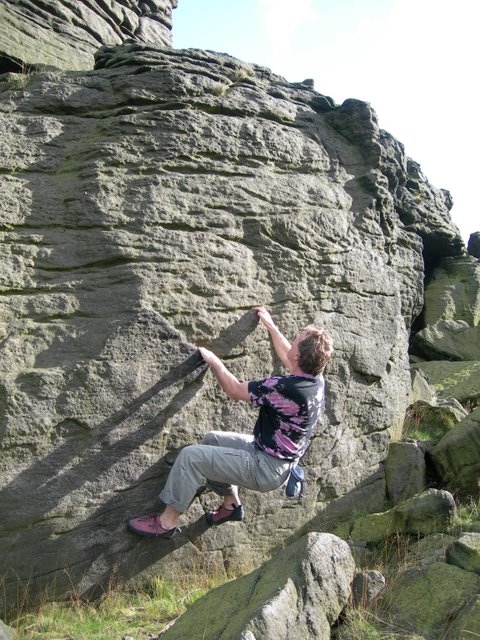
We're talking Shark’s Fin Soup (1986; 6m, once HS 4c, currently HVS 4c), Burbage North, Peak District, here. Someone's recently climbed the relatively trivial Shark's Fin on a boulder somewhere in the Himalaya, but this thread is about 'Soup' (as it's known by the cogniscenti) and where it might actually go. One other person, at least, is interested.
Here’s a tale of history being made, unmade, falsely recorded, then falsehood becoming reality, possibly a mistaken reality at that. Even Joseph Stalin would have been impressed, if it wasn’t so completely trivial.
Shark’s Fin Soup (1986; 6m, HS 4c). It was my first new route.
We're talking Shark’s Fin Soup (1986; 6m, once HS 4c, currently HVS 4c), Burbage North, Peak District, here. Someone's recently climbed the relatively trivial Shark's Fin on a boulder somewhere in the Himalaya, but this thread is about 'Soup' (as it's known by the cogniscenti) and where it might actually go. One other person, at least, is interested.
Here’s a tale of history being made, unmade, falsely recorded, then falsehood becoming reality, possibly a mistaken reality at that. Even Joseph Stalin would have been impressed, if it wasn’t so completely trivial.
Shark’s Fin Soup (1986; 6m, HS 4c). It was my first new route.
Now, if you've ever had the misfortune to be involved in writing a guidebook or guidebook chapter, you'll know that most new route descriptions (scribbled in the New Route Book in the caff, online at Peak New Routes, wherever) are terrible. Some are just a bit crap, but most are really, really crap. You’re lucky if you can find the start of the route, let alone where it’s supposed to go. Plus, all new-route descriptions, without exception, feature the word ‘obvious’, however obscure, featureless and eliminate the route might be. Sometimes someone knows the name of the first ascentionist (their mate met them in a pub in Pembroke in 1963), sometimes you track down a phone number and found they moved out years ago. Even if you manage to locate them they usually can’t remember a thing, except why their amusing name was so brilliant. In the end you have to go back to first principles: here’s a crag, here’s a list of routes that may or may not be all the same, ignore the word ‘obvious’, and be sceptical of the given grade on the basis that, until proved otherwise, no single human being can grade more accurately than any other.
Shark’s Fin Soup. I was so pleased with myself, and so eager to write it up in the Stoney Café route book I forgot to take note of where it actually was. I think I described it as being half-way between Mutiny Crack and Long Tall Sally, which is a pretty accurate description of where it ended up in the Froggatt guide of 1991.
In fact the route had been done about a year before by Steve Bancroft, as Barry Manilow (VS 5a), and its right next to a whole bunch of other routes that are easy to find and describe. Like The Knight’s Move, for instance. I was surprised. Did no-one check these things? I felt quite guilty for a bit, but what do you do? Then, as now, there is no process for undoing new routes that have made their way into the annals of guidebook immortality. Rather than mess with history, I decided to see if there was potential for a route in the place where the description went. There was, just. I found a crappy little buttress, climbed an arête, and made the guidebook true again (except this was 1992 or so). It seemed to be a reasonable way to restore personal honour and guidebook accuracy at a single stroke.
Trouble was, even on this occasion (which might accurately be termed a ‘retro-first ascent’), I was still a new-route newbie, and I didn't make any notes. So I’m not certain where Shark’s Fin Soup (1992) goes, but I do remember it was a bit easier than Barry Manilow, at about Severe. Then again, no single human being can grade accurately from one decade to the next.
Anyway, I was surprised to see Sharks Fin Soup (sic) in the 2005 Burbage guide (at an astonishing HVS 4c) with an admission of semi-bafflement from the crag writer David Musgrove, who describes it thus: ‘presumably takes the bold and reachy overhang direct on good but suspect holds, about 25m left of Gargoyle Buttress'. Despite having done the first ascent twice already, my name has (disappointingly, I feel) disappeared from the first-ascent list.
Sharks Fin Soup 2005. Where does it go? I’ve no idea, but I plan to go and find it again, wherever it is, and re-live a second rush of retro-first-ascent glory. And I don’t feel guilty any more, in fact I think it’s all rather amusing. Since 2002 I’ve done loads of completely insignificant, obscure, featureless and eliminate new routes, and I don’t mind if Sharks Fin Soup (sic) remains a bit enigmatic.
I do worry about the missing apostrophe though, and even if it was in the right place to begin with. Could it be that the transience and mutability of the apostrophe were destined to reflect the qualities of the elusive route itself? Could it also be that Sharks Fin Soup is Dave Musgrove’s, and Shark’s fin Soup is mine, and they are completely different routes? We may never know.
Finally, has anyone noticed the unlikely symmetry between sharks’ fins and Barry Manilow’s nose? Convergent evolution or mere random biological similarity? As ecological disasters, noses and soup seldom get the discussion they deserve. Barry certainly has the bigger nostrils. Nose Soup – now there’s a brilliant route name.
Monday, October 16, 2006




Monday, October 02, 2006


 Incredible vegetables in Provence, Sept 2006
"I have a mantra that I chant when I get writer's block. I'm gonna keep well my vegetables / cart off and sell my vegetables / I love you most of all / my favorite vegetable / I'm gonna be round my vegetables / I'm gonna chow down my vegetables / I love you most of all / my favorite vegetable. If I have cucumbers nearby, or zucchini, I use them as drum sticks. Celery, never, for they have poor acoustics." Brian Wilson

Thursday, August 31, 2006


Subscribe to:
Posts (Atom)